

Have you ever wondered why some countries seem more successful than others? Global economy rankings give us clear numbers to look at. For example, the United States has produced goods worth 32.1 trillion dollars. When you compare these figures, you see that a strong economy often comes from both a high output per person and a large population. In this post, we explore six key points that bring hope for growth around the world. Stick with us, and you might see finance in a whole new light.
Top 10 Economies by GDP in the Global Economy Ranking
Take a look at these rankings to see how countries stack up when it comes to economic strength using nominal GDP (which simply means the total value of everything produced). These numbers give us a clear snapshot of each country's financial muscle as the world heads toward a total GDP of USD 123.6 trillion in 2026.
| Rank | Country | 2026 GDP Forecast (USD trillions) |
|---|---|---|
| 1 | United States | 32.1 |
| 2 | China | 20.2 |
| 3 | Germany | 5.4 |
| 4 | India | 4.5 |
| 5 | Japan | 4.4 |
| 6 | United Kingdom | 4.2 |
| 7 | France | 3.6 |
| 8 | Italy | 2.7 |
| 9 | Russia | 2.5 |
| 10 | Canada | 2.4 |
Population size and how much each person produces are the key reasons for these differences. Big countries like China and India naturally add up to high total GDP even if what each person produces isn’t as high as in smaller nations. Meanwhile, the United States enjoys high individual productivity along with a large population, which helps push it to the top. In truth, this mix of factors explains why the rankings are so varied, giving us a real sense of each country’s performance on the world stage.
6 Global Economy Ranking Sparks Optimism
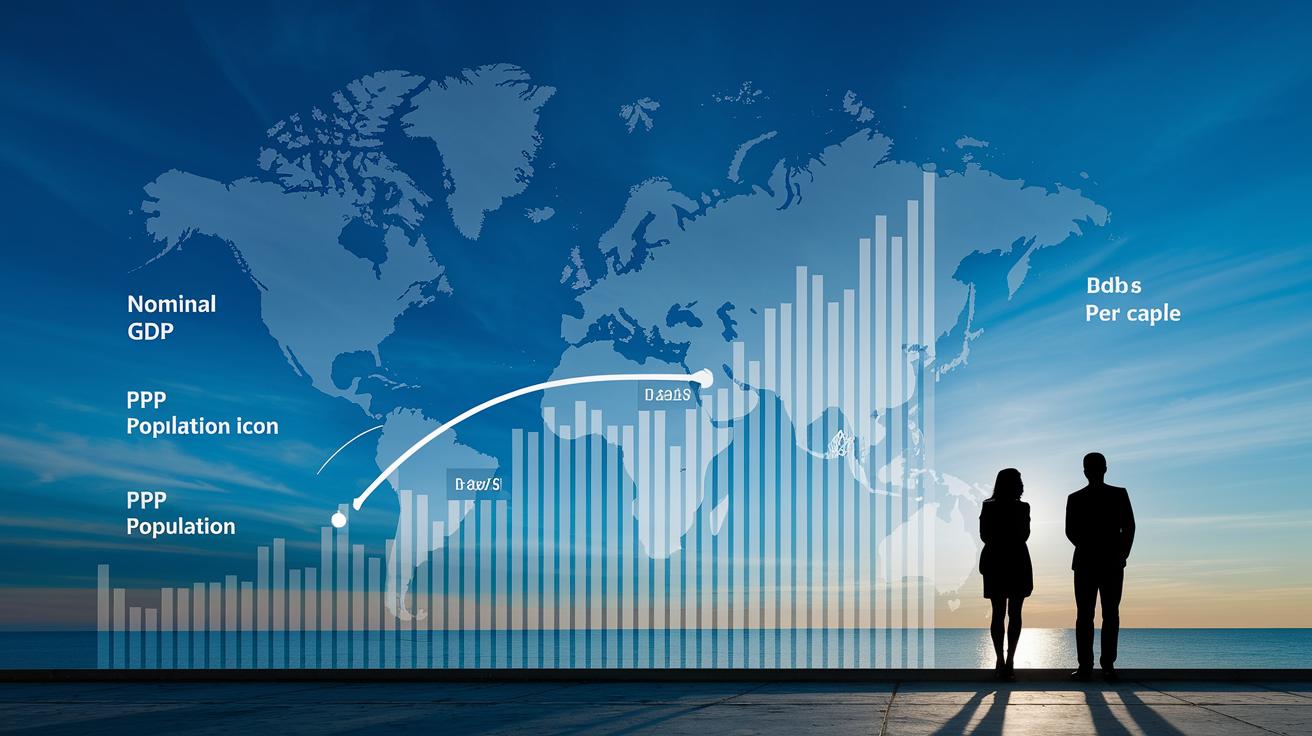
When we look at a country’s economic strength, we start with its nominal GDP. This is just a way to measure the total market value of all the goods and services a country produces. Then we adjust those numbers with purchasing-power parity, which means we consider how differences in living costs affect those values.
We also pay attention to the size of the population and the output per person. A country with lots of people might have a huge total GDP even if each person earns a little less. These factors give us a clearer picture of overall economic health.
Here are some key points we consider:
- Nominal GDP
- GDP using purchasing-power parity
- GDP per Capita
- Population Size
- Real GDP Growth Rate
By mixing these measures, experts create a ranking that shows a fuller view of an economy. They even adjust the weight of each factor to keep the picture balanced. Plus, many experts agree on forecasts to smooth out any short-term ups and downs.
This method shows how countries with huge populations can have a high total output, and how smaller nations can still do well thanks to high individual production. In truth, this balanced approach sparks optimism about understanding and predicting global economic trends.
Emerging Market Positions in the Global Economy Ranking
Emerging markets are shaking up the global scene. New insights show that these countries are growing in different ways and starting to challenge long-established powers. Their steady growth is helping them secure spots once held by traditional economic giants.
India is leading the charge in the Asia-Pacific region. Many recent forecasts and reports make it clear that this country's consistent progress is boosting the region's influence on the world stage. It’s like watching a rising star take center stage.
Brazil, Indonesia, and Mexico are also making big moves. Recent changes in their fiscal policies and structural reforms have sparked renewed market excitement. Think of it as a small shop giving its storefront a fresh new look that suddenly draws in a whole crowd of new customers.
Regional Breakdown in the Global Economy Ranking
Asia-Pacific really drives global growth. In fact, it accounts for 59.4% of the total expansion expected in 2026. Almost six out of every ten dollars from worldwide economic growth are produced in this region, powering the energy of the global market much like an engine in full throttle.
Europe offers a steady, reliable presence thanks to its key G7 economies. You see countries like Germany, which is ranked 3rd, along with the U.K. at 6th, France at 7th, and Italy at 8th. Their solid market practices give us stability and keep the international ranking strong.
Meanwhile, the Americas show a mix of established power and a growing influence. The United States leads the chart, and Canada follows at the 10th spot. Mexico, on the other hand, is an up-and-comer and suggests some shifts in regional performance.
Together, these trends reveal how both dominating and rising regions combine to shape the worldwide financial scene. Each area contributes its unique strength, painting a clear picture of the diverse forces at work across our global economy.
Future Forecasts for the Global Economy Ranking
Forecast models mix expert opinions with careful economic study. Analysts look at past data, market trends, and new signals, kind of like watching the weather for storms, to draw different scenarios. They check out key drivers like tech breakthroughs, changes in energy sources, and shifts in what people spend. This approach gives us a picture of when industries might speed up or slow down, which could change national standings over time.
By 2033, big shifts seem likely. India is predicted to climb the ranks and become the world's third-largest economy, fueled by fast industrial growth and strong local spending. Meanwhile, the gap between China and countries like Germany could widen from about USD 14 trillion today to nearly USD 24 trillion, highlighting China’s growing influence. New emerging markets are set to challenge the current leaders, meaning the top ten list might soon include fresh names beyond the typical G7 and BRICS.
Looking ahead, these trends could rearrange the world’s economic balance. With growing gaps and unexpected new players changing the usual order, many countries might need to adjust their strategies to keep up with the evolving financial landscape.
Final Words
In the action, we explored the top ten economies by GDP and broke down how these rankings come to life by measuring key metrics like nominal GDP and per capita figures. We saw emerging market strengths and examined regional differences that shape today’s global market. Medium-term forecasts hint at exciting shifts, including India's rise and China's growing gap with Europe. This post ties together a clear global economy ranking that empowers you to make well-informed investment decisions with confidence and optimism.
FAQ
What does global economy ranking by country mean?
Global economy ranking by country lists nations based on their total GDP. It offers an overview of each nation’s economic strength by comparing market values derived from goods and services produced.
How is the world economy ranking for 2026 determined?
The world economy ranking for 2026 is determined using expert consensus GDP forecasts. These projections use current economic data to estimate future outputs, providing a snapshot of national economic performance.
What are the top 10 largest economies in the world by nominal GDP?
The top 10 largest economies by nominal GDP identify countries with the highest predicted outputs for 2026. This ranking highlights the nations leading in overall market value, reflecting current economic trends.
How is overall GDP ranking different from GDP per capita ranking?
Overall GDP ranking measures a country’s total economic output, while GDP per capita ranking divides that output by its population. The latter gives insight into the average economic productivity of individuals.
What are the 4th and 5th largest economies in the world?
The predicted 4th and 5th largest economies for 2026 are India and Japan, based on current forecasts. Their ranks reflect strong economic output and the impact of growth trends in each nation.
Which country is the number one economy?
The leading economy globally is the United States. Its top position is based on a consistently high GDP, indicating robust market activity and economic influence worldwide.
Is California the 4th largest economy in the world?
California is not the 4th largest economy globally as rankings compare entire nations. While California has a large economy, it is a state and does not qualify for national economic rankings.
Where does the U.S. rank in the world economy?
The United States typically ranks as the number one economy due to its enormous total GDP. This strong market performance confirms its leading role in global economic rankings.
What are the projections for the largest economies by 2050?
Projections for 2050 indicate shifts led by emerging markets and demographic changes. Future rankings may differ from current ones as evolving economic outputs reshape which nations lead globally.